- Forge Prep
- Posts
- ChatGPT hurts
ChatGPT hurts
Notebooks > Chromebooks. NJ school district funding drops.


ChatGPT quietly hurts
Hi there,
Today is a bit of a grab bag of research that we believe parents should be aware of and which influenced us we built Forge Prep.
As always, I read every email response so if you have ideas, questions, etc, please drop me a line by replying to this email.
We’ll start with something close to home. 167 NJ school districts facing budget cuts and what that means. And then the research.
NJ schools and the school erosion cycle
Montclair just closed Renaissance Middle School. The district is drowning in a $20 million budget deficit. 100+ teachers laid off. 30+ student activities cut. Staples stopped delivering paper because the district hadn't paid its bills.
Montclair isn't unique.
Hackensack: $17M deficit. Perth Amboy: $13M. Toms River, East Orange, Lakewood, Middletown: all underwater. Statewide, 167 NJ districts face aid cuts.
The School Erosion Cycle is described in the image below. Once it starts, it can take a decade+ to undue as I detailed it in an analysis I’d written on Montclair.

Source: School Erosion Cycle
It works like this:
Budget pressure hits.
District cuts programs.
Class sizes go up.
Families with options leave.
Enrollment drops.
Enrollment drives funding so the cycle gets worse
Less money. More cuts. More families leave. School closures.
Notebooks over chromebooks
When you walk into many schools, you will see students with headphones on hunched over their chromebooks.
I’ve lamented about chromebooks many times in this newsletter. Now, even media folks are now talking about this as Fortune recently did.
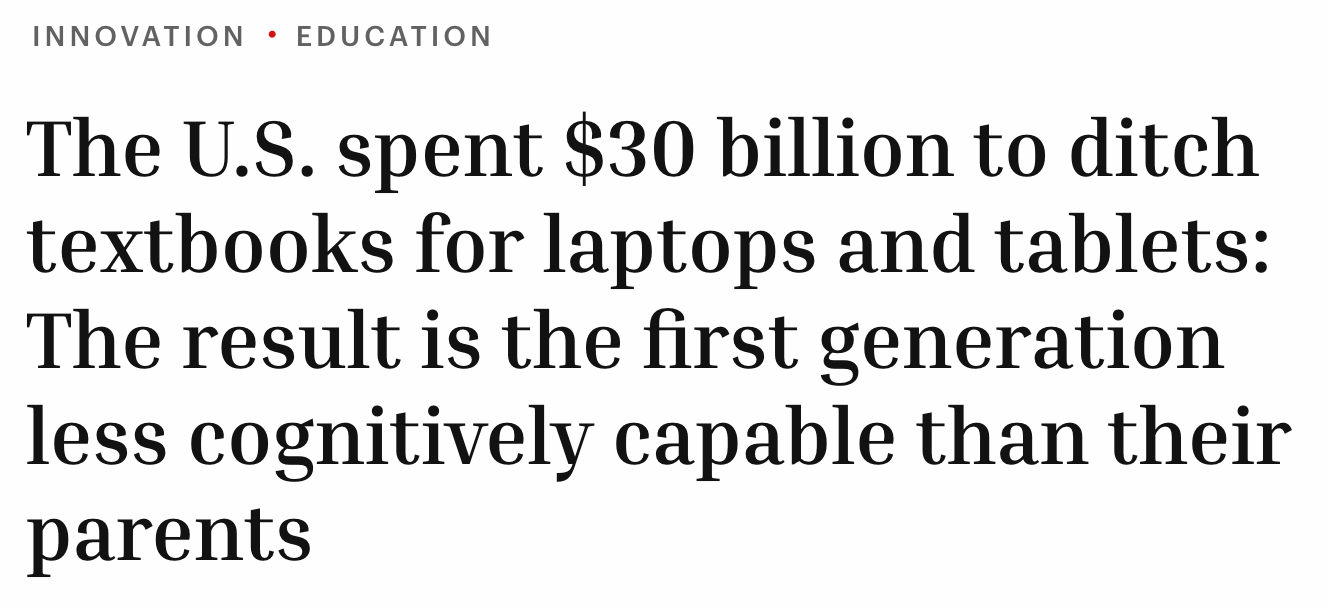
A neuroscience study helps us understand why Chromebooks are so problematic. In 2024, neuroscientists strapped 256 EEG sensors onto students' heads.
They gave students a simple task: write words by hand or type them on a keyboard.

When students wrote by hand, 16 significant neural connections lit up. Memory encoding. Attention. The works.
When they typed? Basically nothing.
The physical difficulty of handwriting is doing something for their brains that typing can't
In short, laptop note-takers produce way more verbatim, copy-paste-style notes. They transcribe without processing. The brain scan data explains exactly why.
At Forge, we love technology when it helps our students create including AI. But when tech is used to consume or outsource and short-circuit thinking, we stay away from it. Because more often than not, the harder path builds stronger connections.
Proof of capability
I loved this story so wanted to share.
Zach Yedegari applied to colleges last year. He had a solid GPA and test scores. And he also created a business on top of ChatGPT doing $30 million in revenue.
All of this while in high school.
As you can see below, he didn’t get into most schools he applied to.

Recently, his startup was acquired My Fitness Pal for a rumored $100,000,000+.
The acquisition happened in his 1st semester of college.
First, unbelievable.
Second, I think we’ll see even more stories like this with the barriers to creation coming down with AI.
Our kids live in a time of rapid change which will create absolutely immense opportunities for them to build, invent and create.
I’m very excited to see what they do.
Also, Zach was on the My First Million podcast with Sam and Shaan (both members of the Forge Guild btw). It’s a good conversation and highlights some of the learning that happens as a byproduct of entrepreneurship.
At Forge, every year students build a business because entrepreneurship is the best natural lab for learning.
Tricking kids into learning
This one's my favorite.
Two groups read the same passage.
Group A was told they'd be tested.
Group B was told they'd have to teach it to another student.
Nobody actually taught anything. They were just told they’d have to teach.

Source: Nestojko et al. (2014), Memory & Cognition
Group B crushed it.
Better recall.
Better organization.
Advantage concentrated on main points.
Just believing they'd have to teach changed how they studied.
The researchers' line that stuck with me: students have effective study strategies they simply don't use unless prodded to.
So our kids already knows how to learn well. They just don't do it when they're told to study for a test. The test framing makes them passive.
While teaching makes them active.
At Forge, our students focus on mastery which is demonstrated through (1) application or at the highest level by (2) teaching.
We believe that a student who can get a peer to competence is the highest form of mastery, and as the research above highlights, it is better than asking them to take a test.

Teaching also makes the work AI-proof. ChatGPT can write your essay. It can't stand up, explain and answer questions about how something works.
chatGPT’s activity trap
Wharton researchers gave nearly 1,000 high school math students access to ChatGPT during practice problems.
The results show chatGPT is a perfect trap.

Source: Bastani et al. (2025), "Generative AI Can Harm Learning," PNAS
Look at the red bars.
Students with ChatGPT crushed their practice sessions. The basic ChatGPT group solved more problems and those on the "tutor" version did even more.
Now look at the gray bars. That's the exam. No AI allowed.
The ChatGPT group scored 17% worse than kids who practiced with zero technology.
And the fancy tutor version?
No better than working alone.
The researchers called AI a "crutch." When they analyzed what students actually typed into ChatGPT, most of them just wrote - “What’s the answer?”
The kicker: students who used ChatGPT believed it hadn't hurt their learning.
They were confidently wrong.
This is the AI trap in education. Outsourcing your thinking.
I know many schools are trying hard to look AI-savvy right now or adopting half-baked AI literacy curricula for students, but I think we’ll look back on this like we look at chromebooks. It’ll be something that was great for technology companies to create users of their tools but ultimately really bad for students.
Note that we do think learning how to use AI is important. But our focus in all things technology is to be very precise on when and how its used. When used for creation, we love technology. When used for consumption, keep it away.
I hope some of this research provokes you to ask questions of your schools.
We, as parents, need to ask more questions.
If any of these research findings surprised you, I’d love to hear from you.
Have a great weekend.
Forge ahead,
Anand
Co-founder, Forge Prep
P.S. If you want to read our prior newsletters, you can see them all here.